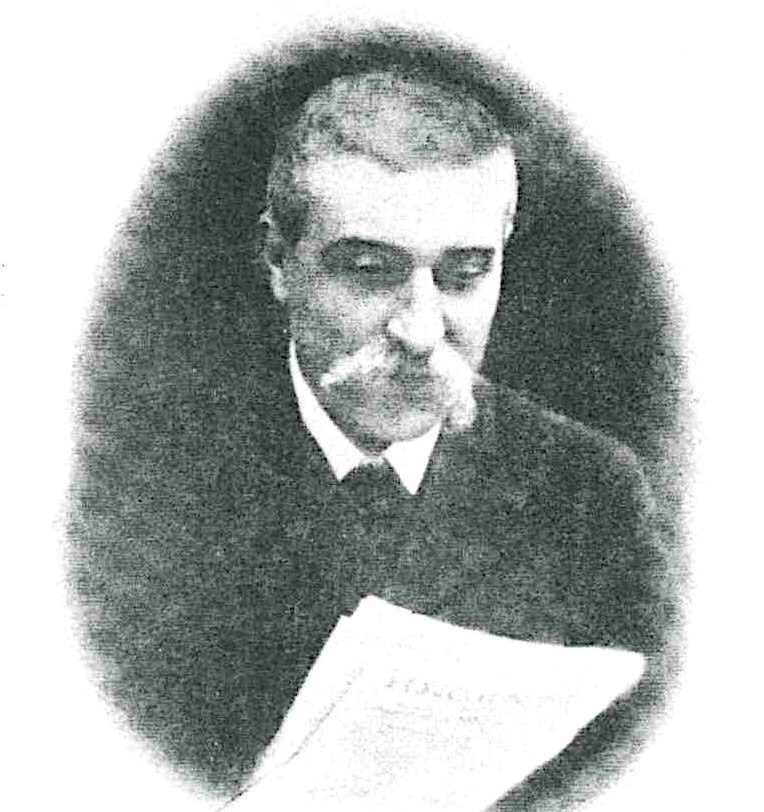
Alessandro Zappata
(Comacchio 1860 - Ancona 1929)
Writer
A scholar of the “Carducci school,” the middle school in Comacchio was named after him.
He was born in Comacchio on December 16, 1860, to Filippo and Caterina Cavalieri d'Oro. His father, Filippo, was a musician and an accomplished composer of operas and sacred music. Orphaned at an early age (his father died on October 30, 1878), he graduated from the University of Bologna with a degree in Law in 1884 and later enrolled in Literature, graduating in 1886.
After teaching in various parts of Italy, he settled at the high school in Ancona, where he remained until his death on February 1, 1929 (probably also due to the lack of a similar higher education institution in his hometown, which he nevertheless visited every year with his wife and children).
A man of deeply felt religious faith, he was publicly commemorated as a multum demissus homo. Somewhat shy and reserved, he was a lover of silence and quiet, indifferent to honors and instead cherishing his free poverty.
Hidden away all day in a small room, he diligently read his Greek and Latin authors and, when love inspired him, wrote a few verses.
A Latinist, in 1896 he composed his first carmen, which received its first commendation in 1897. From then on, every year he wrote and sent a Latin poem to Amsterdam.
On December 29, 1928, just over a month before his death, he completed his thirty-third. Mater Iesu et mater Iudae (The Mother of Jesus and the Mother of Judas) was awarded the gold medal, almost like an Oscar for his career.
Mater Iesu et mater Iudae
The poetic composition is the compassion of Judas' mother. She adds to her pain at her son's “betrayal” the sorrow of seeing him hanging dead from the peaceful olive tree. That tree had been an innocent witness to his misdeed, to the kiss with which Judas betrayed his friend and teacher.
In her, in the mother of the traitor collapsed on the ground, Mary Magdalene and the Mother of Jesus, the Betrayed One, the One who had sacrificed himself as Hostia Amoris even for those who had betrayed him with a kiss, encounter each other as they come from the Sepulchre.
The meeting between the two mothers is the climax of the poem. It is marked on the one hand by the “bloody” words of Judas' mother and on the other by the words of forgiveness of the Mother of Jesus, who sees in the creature before her not the mother of the traitor but simply a mother, a mother aged by grief and innocent.