Guido Monaco da Pomposa
(992ca -1050ca)
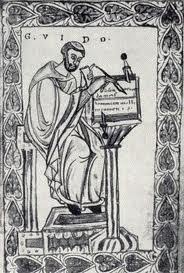
Guido Monaco da Pomposa (992ca -1050ca), detto d'Arezzo.
Music theorist
He was one of the most important music theorists of his time. He became a monk at Pomposa Abbey, near where he was born, and began studying music theory there.
The numerous educational innovations he introduced earned him the hostility of some of his fellow monks.
Although he was not the first to use lines in musical notation, he is traditionally considered the inventor of the modern staff system, with notes placed on the lines and in the spaces. He is also credited with inventing a mnemonic system (manoguidonian) to aid in the exact intonation of the degrees of the scale (hexachord), based on the first syllables of the hymn to St. John the Baptist:
Ut queant laxis Do (C)
Resonare fibris Re (D)
Mira gestorum Mi (E)
Famuli tuorum, Fa (F)
Solve polluti Sol (G)
Labii reatum. La (A)
Sancte Iohannes. Si (B)
This system forms the basis of solmization theory. Having thus established the exact interval between the various notes, Guido invented or perfected a way of representing it accurately. While in ancient notation the neumes were arranged in random order, he thought of gathering them around a line drawn on the sheet corresponding to a pre-established note, to which another was soon added, until he was able to offer a definitive four-line notation system called tetragram.
To establish the height of the semitone, he drew the line corresponding to C in yellow and the line corresponding to F in red. Immediately widespread in the regions of Italy, after the Pope's approval, and more slowly in Germanic schools, his method gave the notation signs the simplest and most stable forms of a square or rhomboid, with or without a tail, forms from which the black square or Roman notation and the rhomboid or Gothic notation emerged.