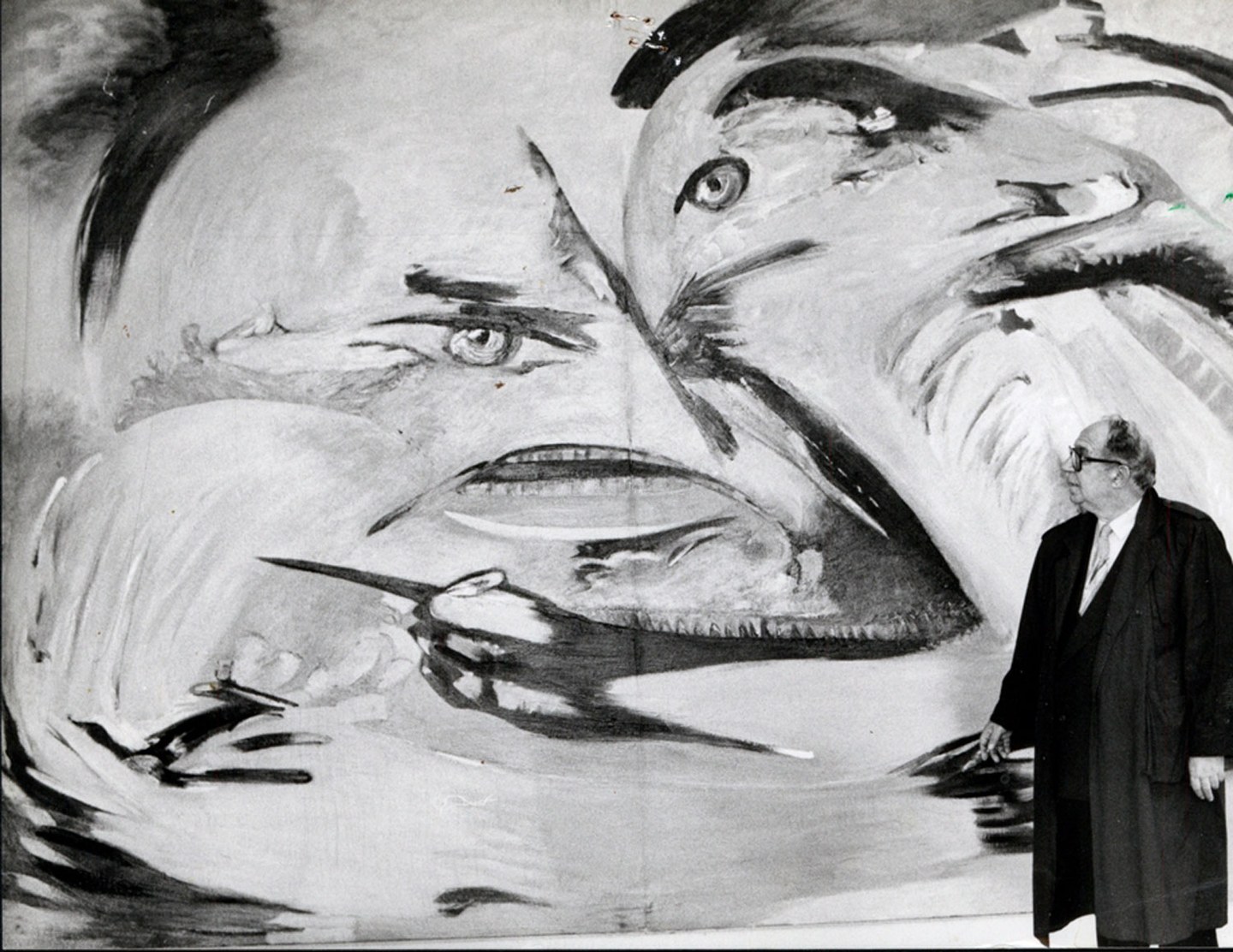
Remo Brindisi
(Roma 1918 - Lido di Spina 1996)
Painter
An epic chronicler of the historical myths of our time, Brindisi is internationally recognized as an artist of extraordinary value. His work, in addition to being part of private collections, is exhibited in over 40 Italian and foreign museum collections.
Remo Brindisi was born in Rome on April 25, 1918, to Fedele (an Abruzzese sculptor) and Elisa Rebutti.
In 1945, he won a prize in a competition organized by Carlo Cardazzo (the great discoverer of the leading talents in postwar Italian painting), marking the beginning of a long-lasting partnership between the two.
After a brief period in Venice, Brindisi settled in Milan in 1947. Immersed in a cultural climate brimming with rebellious energy, heated debates, and creative encounters, he found the innovative stimuli that the serene Venetian environment had never been able to provide. He initially joined the Gruppo Linea, alongside Kodra, Dova, Meloni, and Quasimodo.
Between 1956 and 1957, he created the Via Crucis, followed by L’abbattimeno del mito di Stalin (1958), Il processo al cardinale Mindszenty (1959), and two versions of La Storia del Fascismo (1960–61).
An epic chronicler of the historical myths of our time, Brindisi is internationally recognized as an artist of extraordinary significance. His nonconformism, his visceral rejection of all forms of violence, and his deep sensitivity to the human condition are expressed unambiguously, even before they take the form of unsettling images. A lyrical poet yet a meticulous observer of reality, the artist recounts, in his more recent works, the political events beginning with the bombings of 1969 and culminating in the massacre on Via Fani.
Remo Brindisi was also a writer, poet, music critic, lecturer, promoter of cultural initiatives, and patron of the arts. For his political engagement, he served as a municipal councilor in Comacchio for the Christian Democracy party from 1975 to 1980.
Confirmation that his identification of art with social activities is not only a firm personal belief but also a civic duty is provided by the creation, at his own expense and without any public funding, of the Remo Brindisi Alternative Museum, inaugurated in 1970, dedicated to the integration of the arts. The bold structure, designed by architect Nanda Vigo, is located between the sky and the sea in the picturesque setting of the Lidi Comacchiesi. Now, in accordance with the artist's will, the Remo Brindisi House Museum is owned by the Municipality of Comacchio.
Remo Brindisi died in 1996 at his house museum in Lido di Spina.