Ferrara within the walls
Exploring the city with Giorgio Bassani
These itineraries are an invitation to explore the streets of Ferrara and discover them – or rediscover them – through the eyes of the writer.
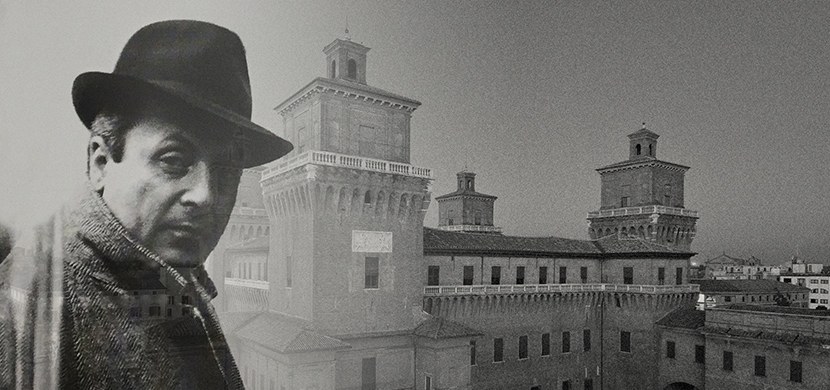
Born in Bologna in 1916, we know that Bassani spent his childhood and youth in Ferrara, which he later made the star of his narrative oeuvre. The link between the author and city of the Este family has certainly been controversial yet indissoluble, so much so that he made the capital of the Po Valley a character of choice rather than a mere backdrop.
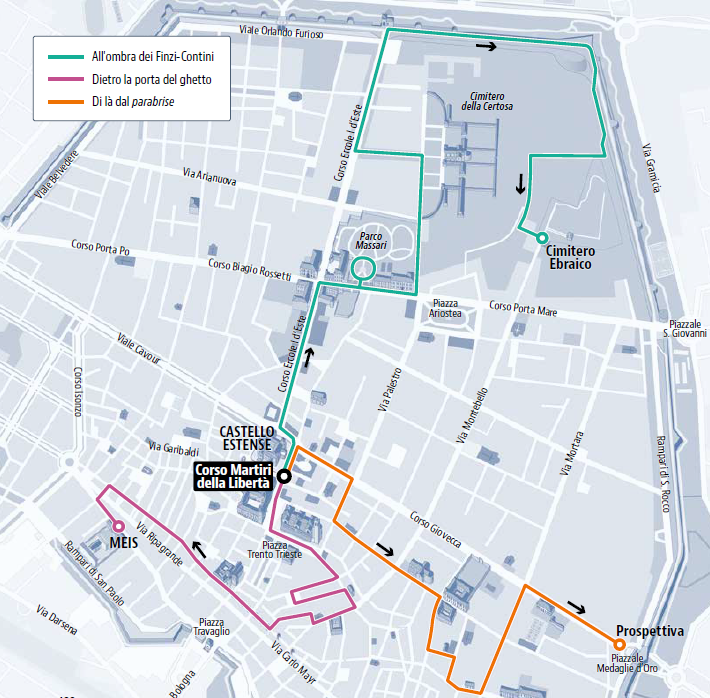
This is how the three itineraries found herein were chosen, a bike ride and two walks, ideally mimicking the movement of the writer, who tends to go from the inside outwards, opposing the centripetal force silently imposed by the walls as he does. Each itinerary starts from the centre of Ferrara and heads in a different direction towards the outside of the city. However, each one also finds a characteristic destination within the city walls that's uniquely tied to Bassani and his life: the MEIS - Museum of Judaism and the Holocaust (formerly a prison in Via Piangipane, where the writer was detained in 1943), the Prospettiva in Corso Giovecca, and the tomb of Giorgio Bassani in the Jewish cemetery in Via delle Vigne.
These itineraries are designed both for those who already love Bassani's work, intended to give substance to the black and white of the pages, but also for those who wish to learn about his work quite literally 'through' Ferrara. In both cases, the itineraries concretize the inevitable and constitutive recursion that binds Bassani to the city where he was born and raised.
The wall of the moat
In his fiction, Bassani gathers the remains of all the victims of that night at the foot of the moat of the Castle; the reader will find Pino Barilari's pharmacy, which witnessed the massacre.
In 1960, Florestano Vancini from Ferrara made his directorial debut with the film La lunga notte del '43 (The Long Night of '43).
In the footsteps of Bassani