Cathedral
Timetable
Weekdays: 7.30 - 12.00; 15.30 - 19.00
Holidays: 8.00 - 13.00; 16.00 - 20.00
Weekday Masses: 8.00 - 10.00 - 18.00
Holiday Masses: 8.30 - 10.00 - 11.30 - 17.30 - 19.00
Pre-holiday Mass: 18.00
Prices
Free entrance
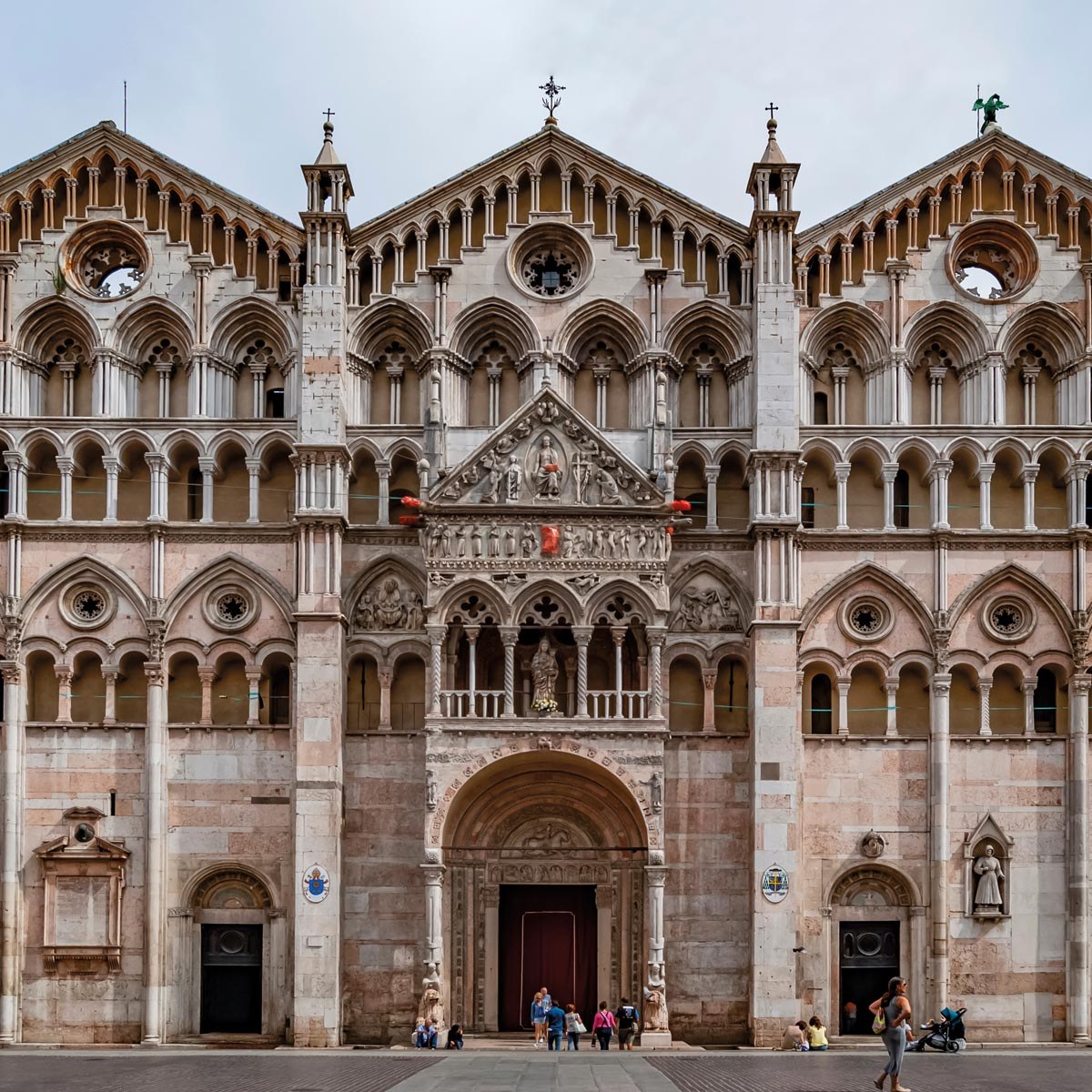
The cathedral of Ferrara dates from the 12th century and bears witness to all the historical periods of the city. The outstanding façade, divided into three sections, was begun in Romanesque style, still visible in the lower part.
Note the St. George and the scenes from the New Testament above the central door, the work of the sculptor Nicholaus (1135). The upper part was built some decades later in a Gothic style and besides the numerous small arches and the splayed mullioned windows presents an extraordinary Last Judgment by an unknown sculptor over the central loggia.
The interior of the cathedral was completely refurbished in the 17th century in a grandiose classical style. Along with the ostentatious pictorial decoration older works can be admired such as the bronze statues of the Crucifixion and of Saints George and Maurilius, by Nicolò Baroncelli and Domenico di Paris (15th cent.) in the right transept; on the altar alongside, the splendid canvas of the Martyrdom of St Lawrence by Guercino (17cent.) is to be seen. The bowl-shaped apse is vaulted with the grandiose Last Judgment by Bastianino (16th cent.). In what is his masterpiece the artist displays great dramatic force, imagination and unconventionality in this work clearly inspired by Michelangelo.
The side facing Piazza Trento e Trieste is decorated with two galleries and small columns of various shapes. At ground level is the Loggia of the Merchants, occupied by shops since Medieval times. Half way along the south side what remains of the Porta dei Mesi, demolished in the 18th century can still be seen; some of its sculptures are conserved in the Cathedral Museum.
The imposing Renaissance campanile, in pink and white marble, is an unfinished work attributed to Leon Battista Alberti. The brickwork apse, whose sober design is lightly embellished by terracotta arches and marble capitals, is the work of Ferrara’s top architect and town planner, Biagio Rossetti.
Dogs are not allowed.
Itineraries related to this point of interest